
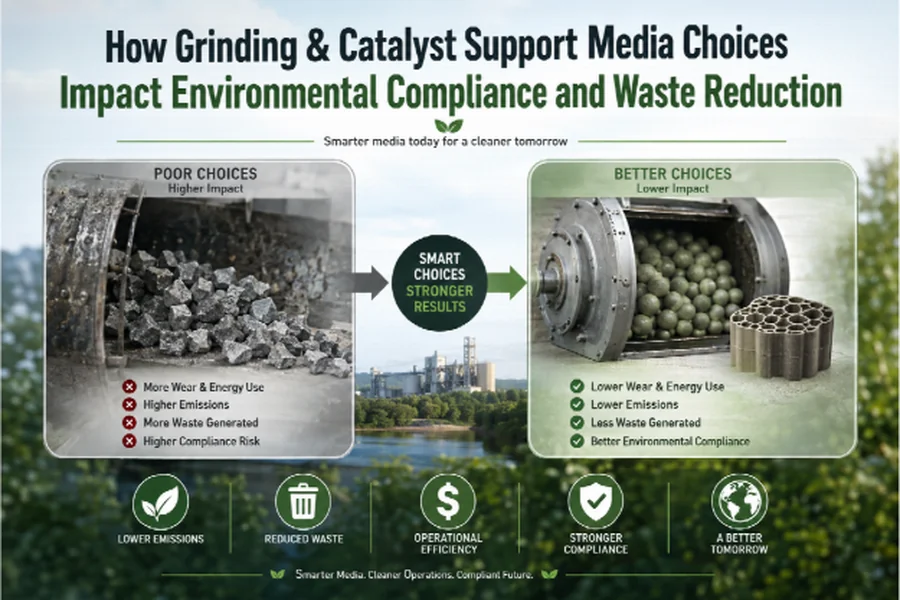
The industrial world’s under way more pressure than it used to be to clean up its act. Regulators are tightening the rules, customers are asking harder questions, and plants everywhere are being asked to do more with less waste. And here’s the thing a lot of operations managers don’t realize until it’s pointed out to them: the industrial milling media sitting inside your mills and reactors plays a bigger role in your environmental footprint than you’d think.
Why Media Choice Is an Environmental Decision, Not Just a Technical One
It’s easy to think of media selection as purely a performance question, does it grind fast enough, does it hold up under pressure. But every bit of media that wears down and needs replacing is material that’s got to be manufactured, shipped, and eventually disposed of. Choose poorly, and you’re not just hurting your throughput, you’re generating more waste than you need to.
Low-quality media wears fast, contaminates your product, and needs replacing way more often than it should. That’s more scrap, more downtime, and more material heading to landfill or reprocessing. Get the media right, and a lot of that waste just disappears from the equation.
Contamination Is a Bigger Deal Than Most People Realize
Whengrinding media breaks down during processing, tiny particles can end up mixed into your final product. In a lot of industries, that means batches get flagged, reworked, or scrapped entirely, and that’s waste on top of waste. Choosing high-purity, chemically inert media (ceramics like alumina or zirconia, for instance) cuts contamination risk way down and keeps your yield where it should be.
Tumbling and Finishing Processes Aren’t Immune Either
It’s not just grinding operations that carry an environmental cost.Tumbling media used in deburring, polishing, and finishing processes wears down too, and the runoff from those processes has to go somewhere. Picking media with a longer service life and lower breakdown rate means less sludge, less wastewater treatment burden, and less material being cycled through your facility unnecessarily.
Catalyst Support Media and Reactor Efficiency
In petrochemical and refining applications, a poorly chosencatalyst bed support can lead to channeling, uneven flow, and reduced catalyst life, all of which means more frequent catalyst replacement and more waste generated over the life of the reactor. A well-engineered support bed keeps the reaction running efficiently for longer, which is a pretty direct line from media choice to reduced environmental impact.
Longer Media Life Means Less Waste, Full Stop
At the end of the day, the simplest way to cut waste is to buy media that lasts. Whether that’sstainless steel tumbling media that holds up to repeated cycles without breaking down, or a ceramic grinding media that resists wear far longer than standard steel, the math is the same: fewer replacements, less scrap, less material moving through your waste stream.
The Bottom Line
Environmental compliance doesn’t have to mean overhauling your whole operation. Sometimes it starts with something as simple as the media loaded into your mill or reactor. Get that choice right, and you’re cutting waste, improving product quality, and staying ahead of tightening regulations, all at the same time.