
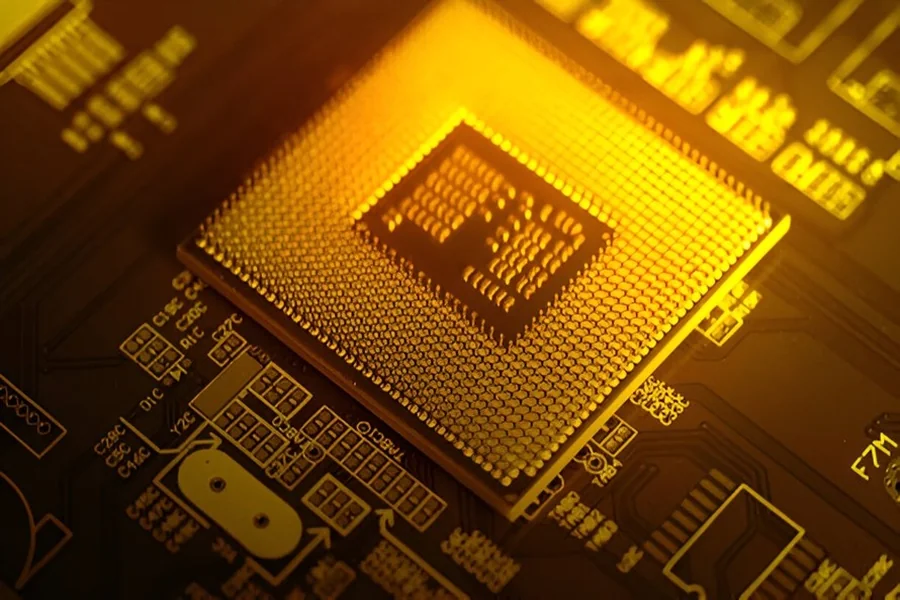
The IC Substrate Circuit Board plays a vital role in the modern semiconductor industry, acting as the critical interface between integrated circuits (ICs) and the larger printed circuit board (PCB). With the increasing demand for smaller, faster, and more efficient electronic devices, IC substrates have emerged as a key enabler of advanced packaging solutions. Unlike traditional PCBs, IC substrates are designed with extremely fine wiring, high-density interconnects, and superior material properties that allow them to support the miniaturization and high performance of today’s semiconductors. From smartphones to data centers, almost every advanced electronic device relies on IC substrate technology to ensure stable signal transmission, reduced power loss, and reliable long-term performance.
Structure and Materials of IC Substrate Circuit Board
The IC Substrate Circuit Board is typically fabricated using high-performance materials that can meet the stringent demands of semiconductor applications. Common materials include BT (Bismaleimide-Triazine) resin and ABF (Ajinomoto Build-up Film), which provide excellent insulation, dimensional stability, and high heat resistance. A typical IC substrate consists of multiple layers of conductive copper circuits separated by dielectric layers, forming a compact and highly reliable structure. These layers are interconnected using microvias and through-holes to achieve high-density wiring. The design of IC substrates focuses on maintaining precise line width, spacing, and thickness control, as even the smallest variation can impact performance in high-speed and high-frequency applications.
Advantages of IC Substrate Circuit Board
The IC Substrate Circuit Board offers several advantages over conventional PCBs, making it indispensable in semiconductor packaging. One of the key benefits is its ability to achieve miniaturization while maintaining high performance. The fine wiring capability and high-density interconnects enable chips with millions of transistors to be effectively connected to the system-level PCB. Another advantage lies in its excellent electrical performance, as substrates are designed to minimize signal loss, reduce crosstalk, and maintain impedance control, which is essential in high-speed communication devices. The thermal management capability of IC substrates is also superior, allowing heat generated by advanced chips to dissipate efficiently, thereby enhancing device reliability. Furthermore, IC substrates provide a stable mechanical base that protects delicate silicon chips while supporting increasingly complex designs.
Applications of IC Substrate Circuit Board
The IC Substrate Circuit Board has widespread applications across a variety of industries that rely on advanced semiconductor technology. In consumer electronics, they are used in smartphones, tablets, and wearable devices, enabling compact designs with powerful performance. The data center and server industries rely heavily on IC substrates to support processors, GPUs, and memory chips that handle massive amounts of data with speed and efficiency. Automotive electronics, which now incorporate advanced driver-assistance systems (ADAS), infotainment, and electric vehicle (EV) technologies, also depend on IC substrates to ensure reliable and safe operation under harsh conditions. Medical devices, aerospace systems, and telecommunications infrastructure are other critical areas where IC substrates enable miniaturized yet high-performance solutions.
Evolution of IC Substrate Circuit Board Technology
The IC Substrate Circuit Board has evolved rapidly to keep pace with the advancement of semiconductor manufacturing. Early designs were relatively simple, with limited layer counts and moderate wiring density. However, with the rise of high-performance computing, 5G networks, and artificial intelligence, the demand for substrates with finer wiring, higher layer counts, and improved thermal performance has skyrocketed. Technologies such as flip-chip packaging and system-in-package (SiP) rely on advanced IC substrates with complex interconnections to achieve higher levels of integration. Today, manufacturers are developing substrates with ultra-thin build-up layers, advanced materials, and even embedded passive components to further enhance performance. This evolution highlights the crucial role of IC substrates in enabling the next generation of electronics.
Challenges in IC Substrate Circuit Board Development
While the IC Substrate Circuit Board offers tremendous benefits, its development and manufacturing come with challenges. Producing ultra-fine wiring with precision requires advanced photolithography and etching techniques, which significantly increase production complexity and cost. The choice of materials is also critical, as substrates must balance electrical, thermal, and mechanical properties to meet the demands of different applications. Additionally, as chip designs continue to scale down, the substrate must keep pace in terms of density and reliability, which requires constant innovation in manufacturing technology. Supply chain stability is another factor, as the global demand for IC substrates has increased dramatically, putting pressure on manufacturers to expand capacity while maintaining quality standards.
Importance of IC Substrate Circuit Board in Modern Electronics
The IC Substrate Circuit Board is far more than just a support structure for integrated circuits; it is a fundamental building block that determines the performance, reliability, and efficiency of modern electronic devices. Without IC substrates, it would be impossible to achieve the compact size, high speed, and low power consumption that consumers and industries demand today. As technologies like artificial intelligence, 5G, cloud computing, and electric vehicles continue to advance, the role of IC substrates will only grow in importance. They represent the invisible yet essential foundation of innovation in electronics, bridging the gap between microscopic silicon chips and the macroscopic systems that power our world.
Conclusion
The IC Substrate Circuit Board has become a cornerstone of modern electronics, enabling the performance and miniaturization that define today’s advanced devices. With their high-density interconnects, fine wiring, excellent electrical performance, and superior thermal management, these substrates ensure that integrated circuits can function reliably in demanding environments. From consumer electronics to automotive and data centers, IC substrates support a wide range of industries that rely on cutting-edge technology. For companies looking to adopt this essential technology, partnering with the right IC Substrate Circuit Board Manufacturer is crucial to ensure quality, reliability, and innovation in their products.